
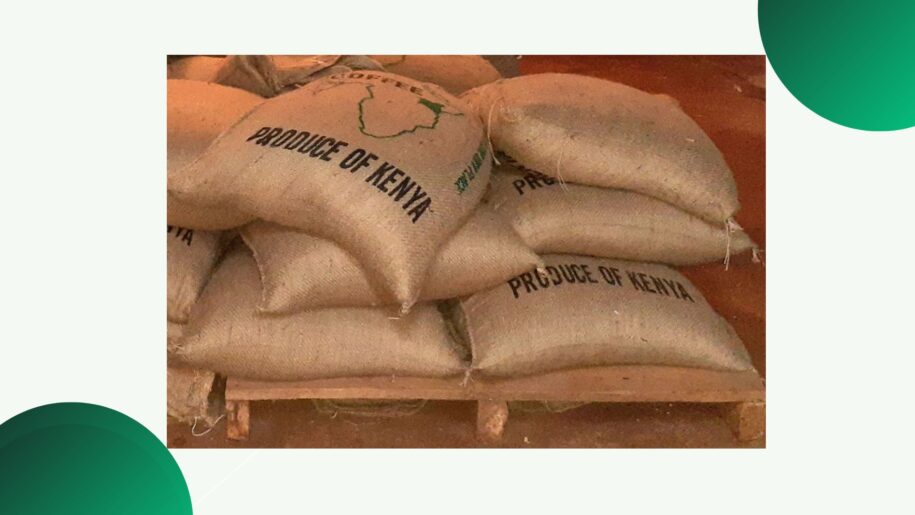
Kenya’s coffee market is experiencing a remarkable upswing, driven by the high prices and strong harvest. For the 2025/2026 season, the outlook is overwhelmingly positive: supply is soaring, prices are rewarding farmers handsomely, and the country is re-establishing its position as a global leader in quality.
This success, however, is being tested by legal challenges that could delay the money getting into farmers’ pockets. For instance, there is a case ongoing regarding the DSS (Direct Settlement System).
The USDA Foreign Agricultural Service forecasts a 13.3% increase in Kenya’s total coffee production for the Marketing Year 2025/2026 (to 850,000 bags), largely fueled by the price response and expected favorable conditions in the biennial production cycle.
The strong performance of the fly crop sets a positive tone for the ongoing main harvest, which is expected to ramp up in the coming months. In most areas, the main crop harvest is in top gear. So far, all expectations have been met.
Some of the reasons why better production is being experienced in this main harvest:
Farmer Incentive: The high prices realized during the fly crop are expected to motivate farmers to adopt sustainable farm management practices, potentially leading to a larger and healthier main crop.
The auctions held in Nairobi are showing concrete evidence that the government’s forecast for a bumper harvest is coming true. The average price for a bag of clean coffee has remained incredibly high, consistently around $385 per bag, $7.7 per kg.
This proves that global buyers are willing to pay a massive premium for Kenya’s quality. In the latest sales, top-quality AA grade coffee fetched a stunning price of $523 per bag, $10.46 per kg, setting a new high for the season.
The high prices have motivated farmers to invest more in their crops (fertilizer, pruning), leading to a massive flow of beans to the market. After a steady start, the amount of coffee sold at the Nairobi Coffee Exchange (NCE) soared by over 70% in November, confirming that the main harvest is arriving in full force.
Regulatory Stability: The regulatory environment appears to have stabilised following recent government reforms. The licensing of regional mills and the streamlined auction process have improved market flow, reducing the logistical delays that plagued previous seasons and creating a smoother path to market for the main crop.
This massive increase in supply strongly supports the government’s goal to achieve a bumper harvest of 850,000 bags this year.
In conclusion, while the volume of the 2025 fly crop was tighter, its superior quality and the associated price premiums successfully maintained high earnings and generated significant positive momentum heading into the highly anticipated main harvest.
Reports from May 2025 by the USDA Foreign Agricultural Service (FAS/Nairobi) provide a forecast for Kenya’s coffee main crop for the 2025/2026 Marketing Year, which typically begins in October.
Here is a summary of the forecast:
Production and Key Drivers
- Production Increase: Kenya’s coffee production is forecast to increase by 13.3 per cent to 850,000 bags (60 kg bags) in MY 2025/2026, up from an estimated 750,000 bags in the previous year.
- Bi-annual Cycle: This increase is partly attributed to coffee plantations being at the peak of the natural bi-annual production cycle characteristic of Arabica coffee.
- Farmer Response: High coffee prices realized in MY 2024/2025 are expected to incentivize farmers to use improved farm practices, such as practicing better fertilizer application methods, better pest and disease control.
- Area Planted: The planted area is expected to increase marginally as the government rolls out a coffee expansion program targeting both traditional and new growing regions.
Exports, Consumption, and Prices.
- Exports: Coffee exports are projected to grow by 10 per cent to 840,000 bags in MY 2025/2026 due to the increased local production.
- Domestic Consumption: Domestic consumption is projected to increase by 6.9 per cent to 62,000 bags, driven by the expansion of coffee service outlets in urban areas and anticipated growth in the tourism sector.
- Prices: Auction prices for Kenyan coffee have been strong, with premium grades like AA commanding high values. Global market conditions, including weather issues in other major Arabica-producing countries like Brazil, are expected to keep prices elevated in the short to medium term.
Over 7 out of every 10 bags sold at the auction are premium grades (AA and AB). The prices are high due to increase demand.
| Metric Performance | (Sales 1-7) |
| Total Cumulative Volume | 70,987 bags |
| Total Cumulative Earnings | $33.08 Million |
| Top-Grade Quality | 77% of all sales consistently comprised Premium Grades (AA, AB, C) |
| Top Buyers | Ibero Kenya, Louis Dreyfus Company, C. Dormans SEZ Ltd, and Kenyacof Ltd. |
| NCE Sale No. | Sale Date | Total Volume (50kg Bags) | Average Prices |
| Sale No. 1 – 5 (Early Crop) | Oct 7 – Nov 4 | Avg. 9,000 bags | $7.66/KG |
| Sale No. 6 – 7 (Main Crop) | Nov 11 – Nov 18 | Avg. 13,041 bags | $7.72/KG |
| Cumulative Total (Sales 1-7) | 70,987 bags | $7.70/KG |
Sale 1
Total Volume Traded:11,179 bags.
Total Earnings: USD 5,222,913 (Ksh 704 million).
Average Price: USD USD 375.24 ($7.50/kg)
AB 3,953 bags worth USD 1.93 million at an average of USD 398, C grade with 3,070 bags worth USD 1.42 million at an average of USD 374, AA grade with 1,024 bags worth USD 590,759.82 at an average of USD 454 per Bag.
Sale 2
Total Volume Traded: 10,770 bags.
Total Earnings: USD 4,987,781.06 (KSh 644.96 million).
Average Price: USD 371.57/bag ($7.43/kg).
Highest Price:USD 477/bag ($9.54/kg) for AA grade.
Sale 3
• Total Volume Traded: 8,674 bags
• Total Earnings: USD 4.38 million (~KSh 565 million)
• Average Price: USD 404.39/bag($8.09/kg)
• Highest Price: USD 511/bag ($10.22/kg)
• Premium Grades (AA, AB, C): 6,288 bags — 72% of total volume
Sale 4
• Total Volume Traded: 7,135 bags
• Total Earnings: USD 3.19 million (~KSh 409 million)
• Average Price: USD 356.75/bag ($7.14/kg)
• Highest Price: USD 475/bag ($9.50/kg)
• Premium Grades (AA, AB, C): 4,272 bags — 60% of total volume
Sale 5
• Total Volume Traded: 7,147 bags
• Total Earnings: USD 3.47 million (~KSh 448 million)
• Average Price: USD 389.50/bag ($7.79/kg)
• Highest Price: USD 465/bag ($9.30/kg)
• Premium Grades (AA, AB, C): 5,078 bags — 71% of total volume
Sale 6
• Total Volume Traded: 13,786 bags
• Total Earnings: USD 6.87 million (~KSh 887 million)
• Average Price: USD 401.05/bag ($8.02/kg)
• Highest Price: USD 523/bag ($10.46/kg)
• Premium Grades (AA, AB, C): 10,551 bags — 77% of total volume
Sale 7
Total Volume Traded: 12,296 bags
• Total Earnings: USD 5.89 million (KSh 765 million)
• Average Price: USD 386.01/bag ($7.72/kg)
• Highest Price: USD 474/bag ($9.48/kg)
• Premium Grades (AA, AB, C): 9,500 bags, 77% of total volume
The Major Challenge:
EU Deforestation Regulation (EUDR) Compliance.
The European Union is Kenya’s largest coffee export market (accounting for 55-60% of total exports). Compliance with the EUDR is a non-negotiable lifeline for the sector in 2026. The EUDR deadline is December 30, 2025 (for large companies) and June 30, 2026 (for small enterprises). Exporters must provide geolocation coordinates (GPS polygons for farms over 4 hectares) and a due diligence statement to prove the coffee is “deforestation-free” from December 2020.
The Government of Kenya has committed to funding a nationwide geo-mapping and data collection exercise for smallholder farmers to ensure no one is left behind. This multi-agency effort is rapidly mapping the 33 coffee-growing counties.
The Payment Problem (Suspended Reform)
The government’s plan to revolutionize how farmers get paid is currently on hold:
The Direct Settlement System (DSS) was designed to send 80% of sales money directly to the individual farmer’s bank account within three days of the sale. This would stop local corruption and end payment delays.
The DSS has been suspended by the court until May 2026. For this incredibly profitable harvest, the money will continue to be processed through the old system, which has often been criticized for delays and a lack of transparency. This puts the cash from the current boom at risk of being held up or misused.
The 2025/2026 season is a resounding success story for Kenya’s coffee farmers. The numbers confirm a powerful economic revival is underway, driven by premium quality and strong global demand.
The immediate focus for the government must now be on two key areas: resolving the payment system deadlock to ensure farmers receive their boom money fairly and on time, and successfully completing the EU farm mapping to secure the sector’s future access to the international market.
The outlook for Kenya’s main crop in the 2025/2026 season is optimistic, with projections for higher yields driven by natural production cycles and positive farmer investment.
Book a Meeting to learn how we can support your coffee sourcing needs.
Request a Quote or Sample from our partner farms.
- Kenya Coffee Market Outlook for the Main Crop 2025 to 2026 - December 1, 2025
- Uganda Coffee Market Trends For The 1st Quarter of 2025 - May 15, 2025
- Sowing Seeds of Hope to Kahiraini Coffee Society - August 28, 2024