
This August 2026 East Africa Coffee Market Outlook round-up is s glance of what’s happening on the ground across four key origins this month: Kenya, Tanzania, Uganda, and Ethiopia. From crop development and weather risk to market dynamics and buyer positioning, here’s what roasters and green buyers need to know right now.
Kenya: Main Crop Building Toward a Strong 2026/27
Crop conditions. Across the central highlands (Nyeri, Kirinyaga, Murang’a, Kiambu) and the eastern slopes, trees are moving through the critical berry expansion and hardening stage for the main crop, which will be harvested October 2026 through January 2027. Crop health remains strong following supportive rains earlier in the year.
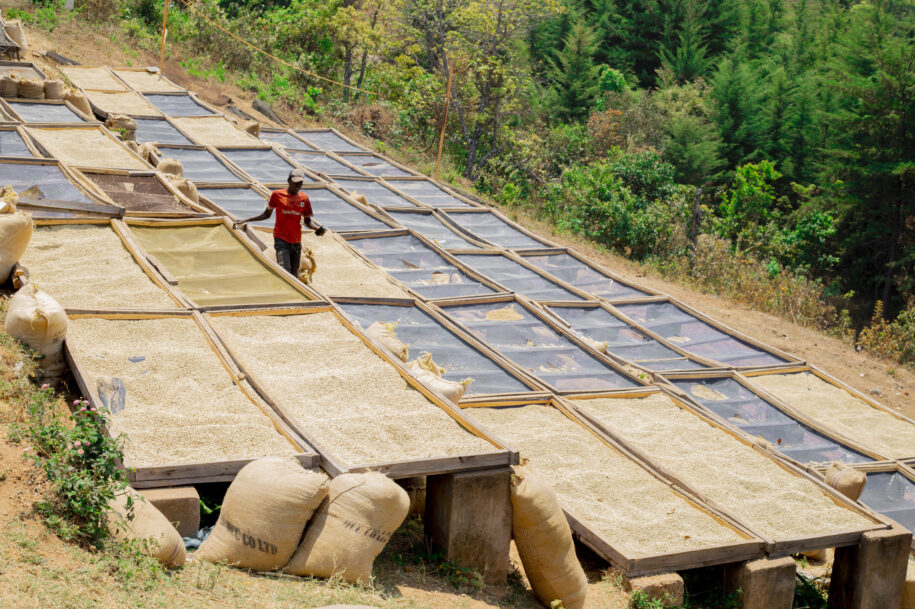
Meanwhile, the early fly crop (harvested May–July) has finished processing at the wet mills. Parchment is completing dry milling and grading now, and early cupping shows strong clarity, vibrant phosphoric acidity, and good bean density. Experimental and special-process lots (anaerobics, honeys) from progressive estates and washing stations are in final rest and moisture stabilization on the drying beds ahead of hulling.
Weather. The region is in its typical cold, overcast July–August post-rain transition. Lower temperatures are favoring slow cherry development for the main crop, generally a good sign, correlating with high bean density and complex sugars. Dry-spell moisture stress in select pockets is being watched, alongside routine Coffee Berry Disease and Leaf Rust control ahead of the late-year harvest.
Milling, logistics, and market. Fly crop lots, including classic AA/AB grades and experimental micro-lots, are active at dry mills, and sample availability for green buyers looking at spot or forward bookings is high. The Nairobi Coffee Exchange continues steady trading with seamless digital settlement under the updated Coffee Board of Kenya framework, and Mombasa port logistics remain within normal turnaround windows with no notable vessel delays or container shortages.
Buyer takeaway: Early signs point to solid quality potential for the 2026/27 main crop, particularly from high-altitude cooperative washing stations and specialized estates. Fly crop samples are open for evaluation now, a good window for roasters looking to lock in fresh Kenyan arrivals.
Tanzania: Dry Weather Supports Harvest, Production Set to Climb
Weather outlook (August–September). Conditions are broadly dry and warmer than normal across the growing regions, which is good news for harvest logistics:
- Kilimanjaro, Arusha, Manyara (North): Generally dry and warm, with only occasional showers at higher elevations, supportive of harvesting, drying, and post-harvest handling.
- Kagera and Mara (Lake Zone): Rainfall intermittent and limited; focus is on timely harvesting, drying, and storage while farmers prepare for the next rains.
- Kigoma and Katavi (West): Predominantly dry through August–September, favorable for drying, though isolated showers could add moisture stress on trees awaiting the next rains.
- Songwe, Mbeya, Njombe, parts of Morogoro (Southwestern Highlands): Predominantly dry, good for harvesting and parchment drying; farmers should prioritize moisture monitoring and warehouse ventilation.
- Ruvuma, Mbinga (South): Rainfall low and intermittent, transitioning toward the next main rain season, good drying conditions.
Crop condition. The current crop is generally in good, stable condition. Dry conditions are supporting timely harvest and quality preservation of parchment. Farmers and cooperatives are described as steady and watchful, focused on efficient harvesting and protecting quality through storage.
2026/27 main crop outlook (May–October). Production is projected at roughly 1.6 million 60kg bags, up about 10.3% on the previous season, on the back of favorable growing conditions, improved farm productivity, and maturing rehabilitated coffee fields. Kagera and Mbinga stand out with encouraging prospects thanks to well-distributed rainfall. The overall outlook is positive, though continued monitoring of rainfall distribution through the rest of the harvest remains important.
Market insight. Strong prices and seasonal cash-flow needs are likely to keep farmers and cooperatives focused on liquidity and timely payment; this could push toward faster sales, competitive pricing, shorter payment cycles, and more flexible delivery terms. At the same time, higher expected production and carry-over stocks may moderate extreme competition at origin. July farm-gate prices from TCB were around TZS 12,323/kg for Arabica processed at CPUs, with auction prices near US$7.30/kg, a strong market environment overall.
Key risks:
- Harvest delays from rainfall (Moderate/low): Earlier concerns about rain delaying harvest in Njombe and Kilimanjaro look less pronounced now, but late-season monitoring continues.
- Drying and post-harvest quality (Moderate): Intermittent or unseasonal rain could pressure drying capacity as volumes rise.
- Competition for coffee at origin (Moderate/high watch): Strong global demand keeps competition elevated, though there isn’t yet clear evidence that higher 2026/27 volumes are creating a broad supply squeeze.
Uganda: Strong Production Outlook, but Rain Risk Looms Over the Fly Crop
Weather and seasonal transition (August–December). The Office of the Prime Minister has issued alerts for heavy rains and potential El Niño conditions through the September–December rainy season. Right now, though, unseasonably high temperatures and an extended dry spell persist nationwide, with heavy rains expected soon.
- Southwestern & Central regions: Main Robusta harvest is complete; focus has shifted to farm maintenance, stumping/rejuvenation, and fertilizer application once the rains arrive.
- Harvesting zones (Northern/West Nile, Eastern Elgon Arabica, Southwestern Highlands): Districts including Nebbi, Zombo, Arua, Kasese, Mitooma, Kitagwenda, and Rubirizi are starting fly crop harvest while bracing for heavy rainfall.
Crop condition. Southwestern and Central Robusta has been fully gathered, with attention moving from harvest to tree care and soil replenishment. Fly crops (Arabica and regional Robusta) in the North, East, and select Southwestern districts are in good condition, but the approaching heavy rains threaten drying quality and field mobility.
2026/27 main crop outlook. National production is projected at a strong 6.8-7.2 million 60kg bags. The anticipated September-December rains should replenish soil moisture and support tree recovery and fertilizer uptake in Central/Southwestern regions, but excess rain could disrupt the ongoing fly crop harvest in the North, East, and Highland districts.
Market insight. With the main Robusta harvest concluded in major belts, traders, cooperatives, and exporters are actively holding and hoarding stock in anticipation of further global price gains. That hoarding has constrained spot market liquidity, intensifying competition among buyers and exporters trying to fulfill standing commitments.
Key risks:
- Post-harvest drying and rain damage (High): Heavy rains and possible El Niño during the ongoing fly crop harvest raise serious risk of moisture spoilage, mold, and quality loss.
- Heat and moisture stress (Moderate): Prolonged dry spells and heat ahead of rain onset may stress fertilizer application and rejuvenation work in Central/Southwestern fields.
- Market squeeze and supply withholding (High): Speculative hoarding on hopes of higher prices could produce localized shortages and heighten contract fulfillment risk for exporters.
Weather. ICPAC’s August 19-26 forecast calls for above-normal, and potentially exceptional, rainfall across western and northern Ethiopia, with localized flood risk in those areas. Central Ethiopia, by contrast, may see below-normal rainfall over the same period. Buyers sourcing from western and northern growing areas should watch for potential disruption to drying and transport, while central-zone origins face a different risk profile tied to drier conditions.
Ethiopia: Prompt Position Coffee Gains Commercial Value
No major new harvest revision came out this week. The outlook still points to a larger 2026/27 crop, but high internal cherry prices and elevated financing costs continue to support firm FOB offers.
A reported policy signal suggests the Ethiopian Coffee and Tea Authority is preparing a national Coffee Fund to finance replanting and cushion market shocks. This hasn’t been verified through a detailed official regulation yet, so it shouldn’t be treated as affecting current contracts.
What this means for buyers: With FOB offers staying firm on a larger but not-yet-fully-priced-in crop, coffee that’s already on the water or arriving soon carries real commercial value relative to future-crop positions. Prompt-position inventory, coffee already contracted and moving toward customs release, is worth evaluating on its own terms rather than simply as another origin offer competing head-to-head against future-crop FOB pricing.
The Bigger Picture
This month’s snapshot shows four origins moving at different speeds:
- Kenya is quietly building toward what looks like a strong main crop, with fly crop samples open now for buyers wanting fresh arrivals.
- Tanzania has favorable dry weather backing a projected double-digit production increase, with a competitive but broadly positive market.
- Uganda carries the most weather risk on the board, a strong production estimate shadowed by a real threat of rain damage to the fly crop, compounded by active hoarding that’s tightening spot liquidity.
- Ethiopia underscores a theme buyers are seeing across origins this year: with future-crop pricing firm and policy questions still unresolved, coffee that’s already moving, prompt position, is where the near-term commercial advantage sits.
For roasters and buyers, the throughline is timing: locking in quality now where conditions are favorable (Kenya, Tanzania), watching weather risk closely where it’s elevated (Uganda), and recognizing when prompt inventory is worth more than a forward position (Ethiopia).
Learn more about our East African Origin Services and how they can simplify producer engagement and coffee procurement.
